About Hofstra
Hofstra University is a dynamic private college on Long Island, NY, where students can choose from more than 140 undergraduate and 150 graduate programs in liberal arts and sciences, business, communication, education, health and human services, and honors studies, as well as a School of Law and School of Medicine. | more |
Events

Dr. Sina Rabbany is dedicated to not only his subject matter – bioengineering – but also to teaching – communicating engineering concepts while inspiring students to pursue a degree in engineering.
“If students are just taking math, chemistry and physics, they may lose interest and don’t do well,” he points out. “I make sure to constantly have practical applications, having students read journal articles and work on design projects.” What’s more, he challenges them to deal with open-ended problems, rather than a math or physics problem where there is one right answer.
In this way, students are able to not only understand technology, and why, for example a medical device is created and how it functions, but also its shortfalls, its future needs and how it can do more.
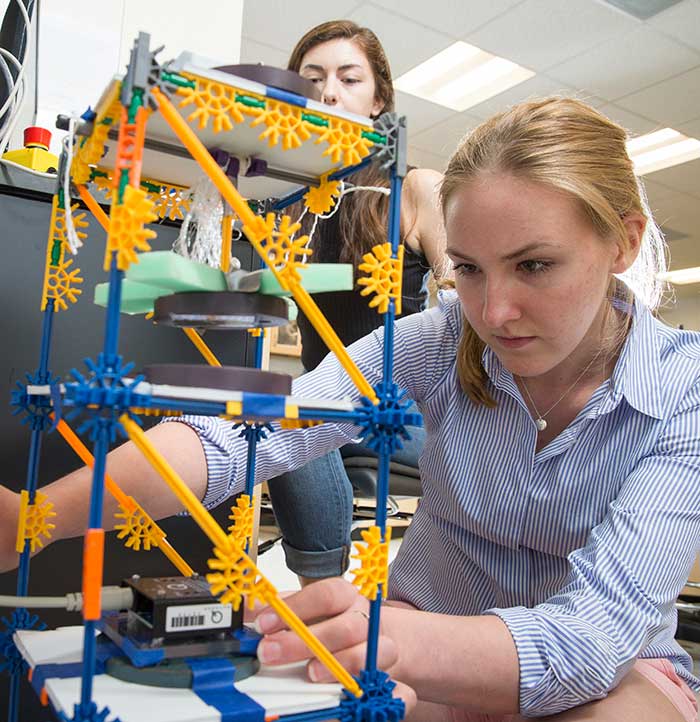
Because Hofstra’s Department of Engineering has no graduate students, research opportunities abound for undergraduates that would not be available at a large university. “At Hofstra, students can work directly with the principle investigator or professor leading a research team,” notes Dr. Rabbany. He is also an Associate Professor of Medicine at Cornell University Medical College, and has brought in his Hofstra students to assist with research there.
Dr. Rabbany encourages students who have yet to determine just how they might use an engineering degree. “I remind them that if they become a biomedical engineer major, they can become a science writer or a patent attorney or earn their MBA,” he says. “To do all these things, you need to know science.”
Danielle Joseph came to Hofstra intending to major in marketing. But when her parents persuaded her to choose a field that incorporated both science and math, she selected Engineering, believing this field would allow her to make a positive impact in the world around her.
Students thrive in a small class-setting, and that was certainly the case for Danielle. She credits Hofstra’s “out of the box” professors, who inspired her passion for engineering and learning. “These professors showed me that learning was not about monkey see, monkey do,” she notes, “but a process that required ingenuity, an understanding of theory, and patience.”
As a Hofstra undergraduate, Danielle delved into her coursework, where critical thinking and analysis was always fostered. She loved thinking for herself and was encouraged – indeed expected – to use her newfound knowledge to solve problems.
Danielle graduated from Hofstra in December 2008 as a biomechanical engineering major. She is now a Ph.D. student at SUNY Downstate Medical Center.
Professor Margaret Hunter teaches Civil Engineering, and has vast expertise in environmental engineering. Her research includes storm water analysis, and it is not unusual to find her working with students in the field, assessing water quality and the impact it has on streams in local municipalities. Such research gives students practical experience – an edge that comes in handy when they begin interviewing for jobs.
Research opportunities are just one of the perks of collaborating with Professor Hunter. As an educator and an advisor, “I like to get to know students and find out what their interests are” in order to recommend course loads and career paths, she says. Professor Hunter is also instrumental in encouraging female students into the discipline so that women can learn about rewarding engineering careers that in the past have traditionally been primarily male. She is pleased to see that now as many as half her students are female, and expects the trend to continue. “Women are attracted to programs where they see other women,” she says.
At Hofstra, Professor Hunter points out, students flourish in the College of Liberal Arts and Sciences, honing not only their engineering skills but, importantly, also their communication skills, providing undergraduates a real edge and a direct route to leadership and managerial positions in the workplace. As Professor Hunter notes: “Our undergraduates are not just learning a science but learning to work with people.”
An authority in both electrical engineering and biomedical sciences, Professor Ghorayeb provides students with an abundance of opportunities. He connects students with external research projects. He offers key strategies for preparing students for post graduate business or academic life. What’s more, he presents a dynamic environment where the learning is never static, and students are always encouraged to ask questions.
Professor Ghorayeb sheds light on his areas of expertise by incorporating electrical engineering concepts to understand the human body. For example, by looking at the body as an engineering system, students better understand how the body interacts with ultrasound to generate pictures of organs, fractures and porosity in bones, and other images.
“Electrical engineering and biomedical sciences are such beautiful areas to study,” he says, adding that students often use their education in these fields as a foundation for further study in other areas.
As the Director of Internships in the Department of Engineering, Professor Ghorayeb also helps students forge a bridge between academics and careers in biomedical, electrical, mechanical, civil and industrial engineering. And as Associate Medical Investigator at The Feinstein Institute for Medical Research at North-Shore LIJ Health System, Professor Ghorayeb provides year-long opportunities to work on research projects sponsored by the hospital or by a local company. These programs give students the valuable prospect of proving themselves as good employees to future employers. In addition, he brings medical students and interns into the university to conduct joint research with undergraduates, providing students with exposure to additional real-world experiences.
“Hofstra University and the Department of Engineering provide a wonderful working environment for the students,” Professor Ghorayeb points out. “And because of the small classroom size, students mingle with faculty directly. With an average of 15 students in a class, we get to know each of our students. We become like a small family.”
He pauses, and adds: “This is why our students are so successful, and may go on to pursue medical school, graduate programs and law degrees at places such as Carnegie Melon, Princeton, Cornell, MIT, and Columbia. We really keep an eye on them.”
Dan Apgar always excelled in math and science. And like his grandfather and uncle before him, Dan studied engineering. He chose to study at Hofstra, with its close proximity to New York City and all the resources it offers, and his home in nearby Levittown. Dan, who earned an academic scholarship from Hofstra, also liked that the program was accredited and that it had a very favorable student-teacher ratio.
Hofstra’s Department of Engineering offers a wealth of resources, including a faculty that is devoted to ensuring educational excellence, a quality that Dan very much found evident. “I liked the fact that the professors were very accessible to the students, which allowed for a sense of familiarity between student and professor,” Dan notes.
A May 2009 Hofstra graduate who majored in Electrical Engineering, Dan is now attending his first year at Fordham University Law School where he will study intellectual property law. Hofstra, with its strong emphasis in both engineering and liberal arts, provided Dan with the tools to succeed.
Notes Dan: “I would recommend the program to future students.”
After graduating with his B.S. in Industrial Engineering in 1996, Joseph Stevens returned to Hofstra to earn an M.B.A. in Management in 2001. Now Joseph serves as Director of Industrial Engineering at Estée Lauder Companies, and is responsible for staff in the company’s Pennsylvania manufacturing and distribution facilities, as well as a strategic projects group on Long Island.
As a transfer student from SUNY Oswego, Joseph selected Hofstra largely because of its reputation. “As a private university, I felt it was better funded and therefore equipped with newer technology as opposed to a SUNY school.”
Hofstra’s low student-to-teacher ratio enabled him to easily interact with professors. “I also enjoyed that many of the professors had real life experiences to share with the students to show them the practical side of what they were learning and how it may apply to situations students might not normally consider,” he says.
As an Industrial Engineering major, Joseph was required to take a broad range of classes in the engineering disciplines, as well as courses in management and the liberal arts, “which I felt made me a better rounded graduate,” he points out. His favorite class? Engineering Economy. “I think everyone should take it as it helps you make better decisions in both the work and home environment,” he notes.
Joseph “highly recommends” the Hofstra Engineering program. “The field of engineering contains many disciplines, each of them continuing to grow, each of them with many opportunities in the work environment,” he says. “I'm partial to Industrial Engineering as I have seen many uses for qualified people with an Industrial Engineering degree in all of the organizations I've worked in.”
Sophomore Deana Gursky is an Industrial Engineering major and hails from Emmaus, PA, located nearly an hour north of Philadelphia. Deana visited Hofstra while still in high school, and immediately loved the campus. What’s more, the faculty and students she met welcomed her. Upon meeting both the chair of the Department of Engineering and the dean of the Honors College, “they made me feel like I was wanted.”
Deana originally planned on majoring in Mechanical Engineering. Yet after meeting with the department chair, she switched to industrial engineering because she felt that it gave her the broadest range of opportunities with her degree.
Although Deana flourished academically, enjoyed her courses, and made new friends, she found it challenging her freshman year to be so far from home. “The faculty was so supportive,” she says, adding that they helped her get through this rocky time by recommending she visit home, see family, and return to class, ready to work. The faculty “is there to help,” she says. In fact, there are so many avenues where struggling students can turn for support, she says, including visiting a professor during office hours, or taking advantage of the department’s tutoring program.
Happy to return to the campus she loves Deana says, “There’d be so many things I’d be losing if I’d left. I’m looking forward to this year.”
Like so many other undergraduates and alumni, Marcelo Lopez chose Hofstra because it offered an accredited engineering program and because of its location. A graduate of Hofstra’s engineering program in 2002, Marcelo chose mechanical engineering because it is a more diversified field than civil or electrical engineering, and deals with many industries including automotive, aerospace, robotics, machinery, and more. “I have always thought that mechanical engineering can be more fun and that it would give me more opportunities to build a career,” he says.
Now an engineer at Northrop Grumman, Marcelo says his Hofstra education prepared him to become a good problem solver, improve his communication skills and boost his strategic thinking.
And although the current job market is tough all around, even for engineers, Marcelo expects a reversal. “I truly believe that in the future the demand for engineers will be critical,” he notes. “It will increase dramatically because there have been fewer and fewer students opting for engineering degrees and because of the worldwide increasing pro-green efforts to seek alternative fuels and resources.”
Professor Saryn Goldberg has always had a natural inquisitiveness about the world and how things work. Engineering, she says, provides the tools to get answers. Teaching engineering “helps students build their intuition so they answer those questions,” she notes. “It’s very satisfying.”
And while applications are always changing and the knowledge base continues to increase, those with strong engineering foundations “learn how to learn,” and will be able to apply that newfound knowledge to get the answers they need.
In encouraging students to ask questions, Professor Goldberg assures them that if they have a question, chances are their classmates do too. “I am constantly asking students to ask questions in class, during office hours, and of each other.”
At Hofstra, with its undergraduate focus and small class size, Professor Goldberg focuses her energy toward teaching students. “I know all the names of my students by day two,” she says. And with no graduate students serving as teaching assistants, “I know how my students are doing. I grade their papers. I walk into the class knowing exactly what they need.”